English
 Türkçe
 Русский
 Español
 Deutsch
 한국어
한국어
 中文
中文
 Български
 Ελληνικά
 Italiano
 العربية
Tears of Stone: The Silent Witness of the Exchange Pains of Kayaköy-Levissi

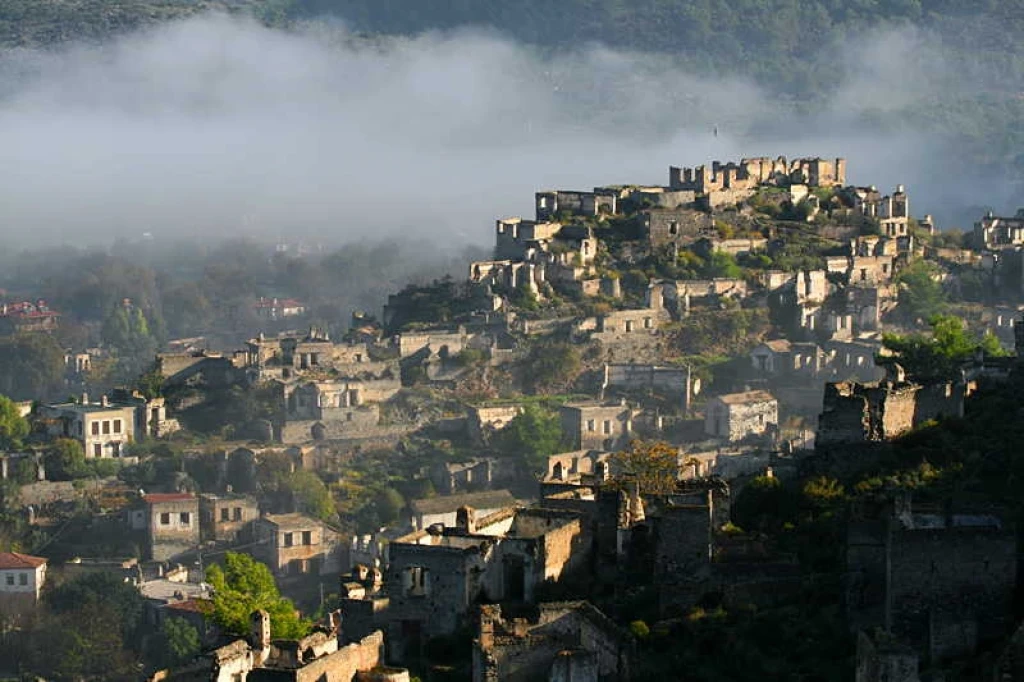
Tears of the Stone: The Silent Witness of the Exchange Sorrows - The History of Kayaköy-Levissi
Perched on a slope just south of Fethiye, Kayaköy, with its stone houses, is not just an abandoned settlement but also a concrete manifestation of uprooted lives and profound longing. Known in ancient times as Karmylassos, in the language of the Greeks as Levissi, and today as Kayaköy, it stands as one of the most poignant witnesses to the population exchange.
Pre-Exchange Coexistence: The Golden Age of Levissi
The documented history of Kayaköy extends back to the ancient Lycian civilization, but the sorrowful beauty it possesses today is rooted in structures built in the 19th and early 20th centuries. At that time, Levissi, with a population of approximately 6,500, mostly Greek Orthodox, was one of the most vibrant trade and social centers in the region.
- Architectural and Social Structure: Hundreds of stone houses, skillfully situated on the slope so as not to block one another's view and sunlight, alongside two large churches (Taksiyarhis and Katopanayi), 14 chapels, schools, pharmacies, a hospital, and numerous artisan workshops, made Levissi a self-sufficient, developed town. The lower floors of the houses were generally used as storages or stables, while the upper floors were designed as living spaces. Cisterns were built on the rooftops of each house to collect rainwater, playing a crucial role in meeting the village's water needs.
- Cultural Wealth: Greeks and Turks lived together in Levissi and the surrounding villages in peace for years. While the Greeks generally engaged in crafts and trade, the Turks were mostly involved in agriculture. These two cultures developed a rich social fabric by respecting each other's languages, traditions, and holidays.
Separation: The Population Exchange of 1923
After the War of Independence, the Population Exchange Agreement, signed on January 30, 1923, between Turkey and Greece, changed the fate of Kayaköy forever. According to this agreement, it was decided that the Greek Orthodox population in Turkey would be relocated to Greece, while the Muslim Turkish population in Greece would move to Turkey.
This decision was a disaster for the people of Levissi, who had lived on their ancestral lands for thousands of years. They had to embark on a difficult journey, leaving behind their homes, fields, churches, ancestral graves, and all their memories, towards an unknown land. Most of the departing Greeks were resettled in a place named "Nea Makri" (New Meğri), near Athens, attempting to keep their homesick feelings for Fethiye alive in their new homeland.
Post-Exchange Silence: Kayaköy
The houses left vacant by Levissi were occupied by Turkish immigrants arriving from Western Thrace. However, the lifestyle and livelihoods of the incoming Turkish population did not align with the structure of Levissi, a town of craftsmen and traders. Mostly engaged in farming, the immigrants could not adapt to the irregular and arid farmland of Kayaköy. After a while, they too left the village, migrating to the more fertile plains around Fethiye.
Following this second abandonment, Kayaköy fell into deep silence. Over time, the roofs of the houses collapsed, the wooden doors and windows rotted, and the streets became overgrown with wild grasses. The damage caused by earthquakes and treasure hunters led to the village being referred to as the "ghost village."
Today, Kayaköy stands as a stone monument to that great human tragedy, the uprooting, and the longing for homeland. As you wander through its cobbled streets, the whispers mingled with the howling of the wind seem to tell the stories of the joys, sorrows, and unending pains of the exchange experienced here once.
Our partners